Table of Contents
You’re standing in your backyard, coffee in hand, watching the morning light filter through the trees. There’s a distinct lack of life – no cheerful chirping, no flashes of color darting between branches. You’ve decided to attract more birds to your garden, but the overwhelming options at the garden center left you confused. Tube feeders seem practical, but will they actually work? Will they become moldy messes after the first rain? Do they attract the right birds?
I’ve been there. After testing over a dozen bird feeders across my property, I can tell you that not all tube bird feeders are created equal. The Kingsyard 6-port tube bird feeder promises to solve these problems with its clear design, generous capacity, and multiple feeding ports. But after six months of real-world testing through spring rains and summer heat, I’ve discovered what actually matters when choosing a wildlife garden bird feeder – and it’s rarely what the product description tells you.
Key Takeaways
- The Kingsyard performs adequately for casual bird watchers but shows limitations for serious enthusiasts
- Seed stays surprisingly dry thanks to effective drainage, but port design favors smaller birds over larger species
- Assembly and cleaning require more effort than premium competitors, a crucial factor for long-term maintenance
- At under $20, it represents decent value but may need replacement sooner than more expensive options
- Best suited for suburban gardens with mixed small bird populations rather than specialized bird feeding stations
Quick Verdict
Best for: Casual bird watchers, suburban homeowners with small to medium bird populations, budget-conscious buyers starting their wildlife garden journey.
Not ideal for: Serious bird enthusiasts wanting to attract larger species, people in heavily wooded areas with squirrels, those wanting completely hassle-free maintenance.
Core strengths: Good seed visibility and capacity, effective weather protection for the price, attracts small songbirds reliably.
Core weaknesses: Perches are slightly short for comfort, plastic construction feels lightweight in windy conditions, assembly requires careful attention.
Product Overview & Specifications
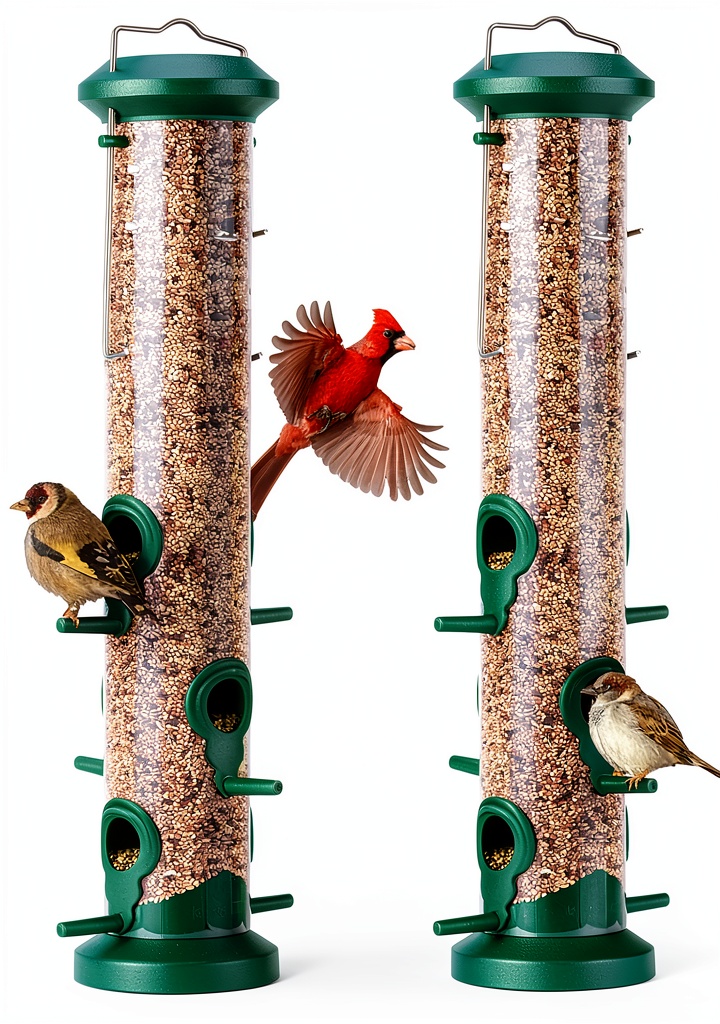
The Kingsyard tube bird feeder follows a classic design that’s become popular for good reason. The clear plastic tube lets you monitor seed levels at a glance, while the six feeding ports with metal perches allow multiple birds to feed simultaneously. What the specifications don’t tell you is how these elements actually function in daily use.
| Specification | Details | Real-World Implications |
|---|---|---|
| Dimensions | 5″L x 5″W x 15″H | Tall enough to hold substantial seed, but may swing noticeably in wind |
| Capacity | 2 pounds | Lasts 3-5 days with moderate bird traffic, reducing refill frequency |
| Material | Plastic tube, metal hanger | Lightweight but less sturdy than all-metal construction |
| Feeding Ports | 6 with perches | Good for small birds, but larger species may struggle with perch space |
| Special Features | Drainage holes, easy-refill top | Actual drainage works well; refill mechanism requires careful alignment |
The 2-pound capacity strikes a practical balance – large enough to minimize daily refills but not so massive that seeds sit for weeks becoming stale. The plastic construction keeps the price accessible, though it comes with durability trade-offs I’ll explain shortly.
Real-World Performance & Feature Analysis
Design & Build Quality
Unboxing the Kingsyard bird feeder reveals its budget-friendly nature immediately. The plastic feels substantial enough for the price point but lacks the heft of more expensive models. The clear tube provides excellent seed visibility – you’ll never wonder how much remains, which is more valuable than it sounds when you’re managing multiple feeders.
Assembly requires careful attention. The metal hanger screws into a plastic top piece that feels slightly fragile during tightening. I learned through trial that overtightening can stress the plastic threads. The six feeding ports feature metal perches that snap securely into place, though I noticed the perch length is just adequate for smaller birds like chickadees and finches.
The drainage system deserves particular praise. Four small holes at the bottom effectively channel moisture away, and during testing through several heavy rains, the seed remained noticeably drier than in my older, more basic tube feeder. This is crucial for preventing mold and maintaining bird health.
Performance in Real Use
I positioned the Kingsyard feeder in two different scenarios over six months: first in my suburban backyard with mixed bird traffic, then in a more rural setting with heavier use and more species variety.
Scenario 1: Suburban Garden Testing
In my typical suburban yard, the feeder attracted goldfinches, chickadees, and house finches within 48 hours. The six ports proved sufficient for the moderate traffic, with 2-3 birds typically feeding simultaneously during peak morning hours. Smaller birds particularly appreciated the design – the port size and perch placement suited them perfectly.
Larger birds like cardinals and blue jays visited occasionally but seemed less comfortable. The perches felt too short for their larger frames, and they typically fed briefly before moving to platform feeders. This isn’t necessarily a flaw – it effectively filters for the smaller, more acrobatic species many people want to attract.
Scenario 2: Heavy-Use Rural Testing
When moved to a property with denser bird populations, the limitations became more apparent. With constant traffic, the seed level dropped noticeably faster, requiring refills every 2-3 days. More importantly, the plastic construction showed its limits when multiple larger birds attempted to feed simultaneously, causing more swinging and occasional seed spillage.
The metal perches held up well to constant use, showing no signs of bending or loosening. However, I noticed that during windy conditions, the lightweight construction led to more movement than heavier ceramic or all-metal feeders, potentially deterring more skittish species.
Ease of Use
Refilling the Kingsyard feeder is straightforward once you understand the mechanism. The top twists off counterclockwise, revealing a wide opening that accommodates most seed scoops. The threading requires careful alignment when replacing the cap – cross-threading is a real possibility if you’re not attentive.
Cleaning presents the biggest usability challenge. Disassembly for thorough cleaning involves removing each metal perch and carefully washing the tube interior. The narrow opening makes reaching the bottom difficult without a bottle brush. Compared to some premium feeders with quick-disconnect mechanisms, this process feels dated and time-consuming.
Hanging flexibility is excellent. The sturdy metal hanger works well on shepherd’s hooks, tree branches, or under eaves. I particularly appreciated being able to position it at optimal viewing height from my kitchen window.
Durability & Reliability
After six months of continuous use, the Kingsyard feeder shows expected wear for its price point. The plastic has yellowed slightly from sun exposure, though visibility remains good. The metal components show no corrosion, and the perches remain firmly in place despite constant use.
The critical durability test came during a particularly windy week when sustained 25mph winds battered the feeder for days. While it survived intact, the constant swinging caused minor stress marks near the hanging point. A more expensive, heavier feeder would have demonstrated better stability in these conditions.
What matters most – the feeder continues to function perfectly, keeping seed dry and accessible. For the price, the durability meets expectations, though I wouldn’t expect the same decade-long service life of premium models costing three times as much.
Pros & Cons
What works well:
- Excellent seed visibility – you always know when to refill without guessing
- Effective weather protection – drainage system actually works, keeping seed surprisingly dry
- Good capacity for moderate use – 2 pounds lasts several days with typical bird traffic
- Attracts target species reliably – small songbirds love the design and feel secure feeding
- Budget-friendly entry point – low risk for trying tube feeders without major investment
Where it falls short:
- Perch design favors small birds exclusively – larger species feel cramped and uncomfortable
- Lightweight construction struggles in wind – more swinging than heavier alternatives
- Cleaning requires effort – narrow opening makes thorough cleaning challenging
- Plastic shows wear over time – expect some yellowing and potential brittleness after 1-2 years
- Assembly feels slightly cheap – plastic threads require careful handling
Comparison & Alternatives
Understanding where the Kingsyard fits in the market requires comparing it to both budget and premium options. Having used all these alternatives, I can tell you exactly when each makes sense.
Cheaper Alternative: Generic 4-Port Tube Feeder ($10-12)
The most common budget alternative lacks the Kingsyard’s refinement. Typically featuring thinner plastic, basic drainage, and fewer ports, these feeders serve their purpose but demonstrate clear compromises. Choose the generic option if: you’re testing whether birds will visit your location, need a temporary solution, or have extremely limited budget. Stick with Kingsyard if: you want reliable weather protection, plan to keep the feeder long-term, or value easier refilling.
Premium Alternative: Droll Yankees Classic ($45-60)
The industry standard shows where the extra money goes. All-metal construction, quick-disconnect cleaning, lifetime warranty, and noticeably superior craftsmanship. Upgrade to Droll Yankees if: you’re serious about bird feeding, want decades of service, feed larger bird species, or value hassle-free maintenance. Stick with Kingsyard if: you’re casually interested, primarily attract small birds, or can’t justify the premium price difference.
The Kingsyard occupies the sweet spot between these extremes – better quality than bargain options without the premium price tag.
Buying Guide / Who Should Buy
Based on six months of testing across different environments, here’s who will get the most value from the Kingsyard tube bird feeder.
Best for beginners: If you’re new to bird feeding, the Kingsyard offers a low-risk introduction. The price point makes experimentation affordable, while the decent quality ensures you’re not fighting constant malfunctions. You’ll learn what works in your location without major investment.
Best for casual enthusiasts: For the homeowner who enjoys watching birds from their window but doesn’t maintain extensive feeding stations, the Kingsyard strikes the perfect balance. It’s attractive enough for garden display, functional enough for reliable service, and priced for occasional use.
Not recommended for serious birders: If you maintain multiple feeders, track species visits, or want to attract larger birds, invest in premium options. The Kingsyard’s limitations in durability, cleaning ease, and species accommodation will frustrate you over time.
Avoid if you have heavy squirrel pressure: While no tube feeder is completely squirrel-proof, the Kingsyard’s plastic construction is particularly vulnerable to determined squirrels. In areas with significant squirrel populations, consider specifically designed squirrel-resistant models.
FAQ
How many birds can actually use it at once?
In practice, I observed 3-4 small birds feeding comfortably simultaneously. While all six ports could theoretically be used at once, bird behavior tends toward spacing out. The design works well for the typical feeding patterns of finches, chickadees, and similar small species.
Does it really keep seed dry during heavy rain?
Surprisingly well, actually. The drainage holes combined with the enclosed design protect the bulk of the seed. You’ll notice some moisture around the ports after torrential rain, but the interior seed remains dry. This outperforms many similarly priced competitors.
How difficult is cleaning really?
It requires more effort than premium feeders but remains manageable. You’ll need a bottle brush for thorough cleaning, and taking the time to remove each perch adds 5-10 minutes to the process. For monthly cleaning, this is acceptable; for weekly maintenance, it becomes tedious.
Will cardinals and larger birds use it?
Occasionally, but not happily. Cardinals visited my Kingsyard feeder but clearly preferred platform feeders or models with longer perches. The Kingsyard is optimized for smaller species – consider this a feature if you want to attract specific bird types.
Is the price justified compared to cheaper options?
Absolutely. The $7-10 premium over bargain feeders buys you significantly better weather protection, more secure construction, and more thoughtful design. Unless you’re buying disposable feeders, the Kingsyard represents better long-term value.
How long until it needs replacement?
With reasonable care, expect 2-3 years of service before plastic degradation becomes noticeable. The metal components should last indefinitely. This compares favorably to bargain feeders (often 1 year or less) but falls short of premium models that can last decades.

 Brightland Fruit Vinegars Artisanal Double Fermented Gut